Blog
Garden Route Dam GARDAG - George Water Crisis - Planning Failure not a water crisis
GARDAG - George Water Crisis 2026
GEORGE'S WATER CRISIS: A PLANNING FAILURE, NOT A RAINFALL PROBLEM
Structural demand, a missing master plan, and a decade of policy contradiction — GARDAG calls on George Municipality to answer six questions the public deserves to hear answeredcontact details

Name: Mr. Brian Cochrane
Business phone: 0721982006
Mobile: 0721982006
Email Enquiry: brianf430@gmail.com
GEORGE'S WATER CRISIS: A PLANNING FAILURE, NOT A RAINFALL PROBLEM
Structural demand, a missing master plan, and a decade of policy contradiction — GARDAG calls on George Municipality to answer six questions the public deserves to hear answeredGeorge is not facing a future water shortage — it is living a structural deficit today.
The Garden Route Dam is currently full — a welcome reprieve after recent rainfall. But do not mistake temporary relief for structural security. The dam’s reliable annual yield covers only 50–68% of George’s actual water demand. The moment the rains ease, the city returns to the same structural deficit it has been living with for years, with no Water Master Plan in sight.
GARDAG wishes to be clear at the outset: this article is not a critique of the men and women who keep George’s water infrastructure running. George’s municipal engineering team is exceptionally hardworking. They respond to crises, maintain ageing systems under pressure, and keep water flowing to nearly 300,000 residents with resources that are rarely adequate for the task. Our questions are directed at planning and governance — not at the dedicated professionals on the ground.
The questions GARDAG raises are ones the public — and those same engineers — deserve to have answered at the policy level. George Municipality is invited to respond through these pages.
“The Water Master Plan was first requested in 2017. It is now 2026. The plan does not exist.”
1. THE STRUCTURAL SUPPLY–DEMAND GAP
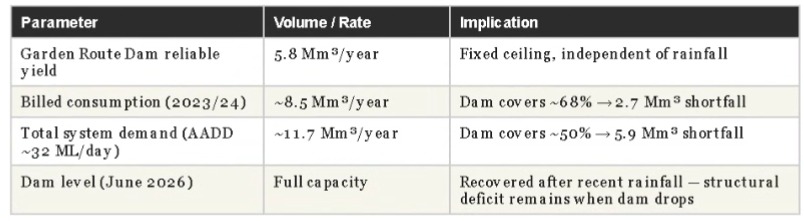
The numbers are not in dispute. The Garden Route Dam’s reliable annual yield is 5.8 million cubic metres. George’s total system demand stands at approximately 11.7 million cubic metres per year. Even against billed consumption alone (8.5 million m³), the dam covers only 68% — leaving a shortfall of 2.7 million cubic metres every year, in every year, regardless of rainfall.
|
✓ IRREFUTABLE FACT #1 — THE GAP IS STRUCTURAL While the Garden Route Dam is currently at full capacity following recent rainfall, this provides temporary relief — not a solution. In a normal or dry year, George requires 5.9 million m³ of additional water beyond what the dam can reliably supply. The deficit is bridged by unsustainable river pumping, unmonitored groundwater, and inter-basin transfers. A full dam today does not erase a structural planning failure that will reassert itself the moment the rains stop. |
2. DENSIFICATION DESTROYS RECHARGE WHILE INCREASING DEMAND
George’s Municipal Spatial Development Framework (MSDF) 2023 makes high-density residential development — at 25 units per hectare — official municipal policy. The consequence is dual and devastating: hard surfaces prevent rainfall from infiltrating the ground, depleting groundwater recharge, while at the same time significantly increasing the city’s demand on that very groundwater.
In 2025–26, more than 632 housing units were approved at Metro Grounds Industria alone. Airport expansion to 2 million passengers by 2029 has received planning approval. Neither project is accompanied by a published water demand projection or augmentation plan.
|
✓ IRREFUTABLE FACT #2 — POLICY SELF-SABOTAGE Every new dwelling approved under the 25 units/ha policy permanently reduces permeable surface area, lowers groundwater recharge, and increases peak runoff. No water balance or environmental accounting is required at the planning approval stage. |
|
✓ IRREFUTABLE FACT #3 — GROWTH WITHOUT WATER ALLOCATION 632+ units approved at Metro Grounds Industria and airport expansion to 2 million passengers add significant demand to a system with a structural supply deficit. The MSDF 2023 states “growth must be carefully managed” — yet the municipality cannot produce a single demand projection tied to new developments. |
3. OPERATIONAL FAILURES: IDLE REUSE PLANT & 24.6% WATER LOSS
While the structural deficit is severe, two operational failures compound it in ways that are within the municipality’s immediate control.
George’s 10 ML/day water reuse plant — capable of returning 3.65 million cubic metres of purified water to the system annually — currently lies idle. Instead, the municipality pumps the Kaaimans and other rivers at maximum capacity, leaving no ecological buffer and no spare yield. Non-revenue water loss stands at 24.6%, meaning nearly one quarter of all water entering the system never reaches a tap.
|
Infrastructure |
Status |
Impact |
|---|---|---|
|
10 ML/day reuse plant |
Idle; rivers pumped instead |
3.65 Mm³/year of purified water not returned to system |
|
Non-revenue water loss |
24.6% (unmetered, leaks) |
Nearly ¼ of all water lost before reaching users |
|
Rivers (e.g. Kaaimans) |
Pumped at maximum capacity, fully allocated to farmers |
No ecological buffer, no spare yield |
|
✓ IRREFUTABLE FACT #5 — LOST WATER EXCEEDS THE DAM GAP 24.6% of system input is lost to leaks and unmetered use. Reducing losses to 15% (the industry standard) would recover approximately 2.3 million m³ per year — nearly the entire 2.7 million m³ shortfall against billed consumption — without sourcing a single additional drop of water. |
|
✓ IRREFUTABLE FACT #6 — KNYSNA HAS A PLAN. GEORGE DOES NOT. In February 2026, Knysna Municipality published a named Water Augmentation Plan: R36 million committed, named tenders, handover dates, the Executive Mayor on record. When asked the same question, George Municipality responded to the George Herald in March 2026 with “long-term planning” — no document, no timeline, no augmentation strategy. The Water Master Plan was first requested in 2017. |
4. ONE BATTLE WON — BUT NO PERMANENT CATCHMENT PROTECTION
In April 2026, after more than two decades of GARDAG advocacy, George Council abandoned planned development on the banks of the Garden Route Dam. This is a critical and hard-won victory. GARDAG’s position was unambiguous: a leaking wastewater system on those banks would have contaminated the dam within 30–50 years, permanently compromising the city’s only primary water source.
But a single council resolution is not a protection strategy. The dam’s wider catchment currently has no legally enforceable permanent protection. There is no buffer zone instrument, no pollution control overlay, and no scheduled hydrogeological audit. As it stands, the dam remains one faulty sewer line away from long-term contamination.
|
✓ IRREFUTABLE FACT #7 — ONE BATTLE IS NOT A STRATEGY While the abandonment of dam-bank development is a critical win, the Garden Route Dam’s wider catchment has no enforceable, permanent legal protection. No buffer zone, no pollution control overlay, no regular hydrogeological audit is in place. |
5. THE MUNICIPALITY’S OWN FRAMEWORK IS BEING VIOLATED
The George MSDF 2023 is not a GARDAG document — it is the municipality’s own legally adopted spatial development framework. It states explicitly that in water-stressed areas, demand must be reduced and growth carefully managed. The table below shows how every major infrastructure decision since its adoption contradicts it:
|
MSDF 2023 Policy Statement |
Ground Truth (2025–2026) |
|---|---|
|
Water demand must be reduced |
24.6% losses unresolved; reuse plant idle; rivers over-pumped |
|
Growth must be carefully managed |
632+ units approved; airport doubling; no demand modelling published |
|
Infrastructure must be protected |
Campersdrift pipeline nearly failed (2021); repeated flooding; no early warning maintenance |
|
✓ IRREFUTABLE FACT #8 — THE MUNICIPALITY’S OWN FRAMEWORK IS VIOLATED The George MSDF 2023 — the municipality’s own adopted framework — explicitly requires water demand reduction and careful growth management in water-stressed areas. Every development approval and infrastructure decision reviewed by GARDAG contradicts that legally adopted commitment. |
6. SIX QUESTIONS GEORGE MUNICIPALITY IS INVITED TO ANSWER
GARDAG poses the following six questions publicly and in good faith. We welcome George Municipality’s response through the George Herald. The public is watching — and listening.
-
Where is the Water Master Plan? Not the BFI list, not the IDP. A long-term supply augmentation strategy with projections to 2035 and beyond, including yield-demand reconciliation.
-
When will the 10 ML/day reuse plant be restored and operationalised? Provide a date and the expected annual return volume.
-
The dam is full today — but for how long? The MSDF densification policy of 25 units/ha permanently increases demand and reduces groundwater recharge. What water balance and recharge analysis was used to approve the 632+ new units and airport expansion — and does that analysis hold when the dam drops again?
-
What is the water demand projection for 2 million airport passengers per year? Quantify tourism-related water cost and how it will be supplied without increasing groundwater mining.
-
What is the long-term protection plan for the Garden Route Dam catchment? Now that the bank development has been abandoned, what buffer zones and monitoring are being formalised?
-
Why is the 24.6% non-revenue water loss not being addressed with a published reduction roadmap and annual targets?
AN INVITATION TO RESPOND
George’s water challenge is not an act of nature. It is the cumulative result of missing plans, unanswered questions, and approved growth without supply accountability. GARDAG does not raise these issues to embarrass anyone. We raise them because the engineering professionals who maintain this city’s water infrastructure deserve the policy backing, long-term planning, and adequate resourcing that only transparent governance can provide.
We acknowledge, with genuine respect, that George’s water and engineering teams work exceptionally hard. What they need — and what residents need — is a Water Master Plan that matches the scale of the challenge they face every day.
George Municipality is warmly invited to respond to the questions raised in this article. The George Herald will publish that response. The conversation starts here.
This article was written by the Garden Route Dam Action Group (GARDAG) for publication in the George Herald, June 2026. Sources: StatsSA Community Survey 2022 | George MSDF 2023 | George Herald 2021–2026 | ACSA Annual Report 2025 | Knysna Water Augmentation Plan (Feb 2026) | GARDAG Hydrological Analysis | George Municipal Disaster Relief Records | Western Cape Department of Infrastructure. All data is publicly available. George Municipality is invited to respond. This article may be reproduced with attribution.
GARDAG — Garden Route Dam Action Group | Community advocacy for over two decades